The Blueprint You Can't Outrun: The Physics of Soul Contracts, Vector Drift, and Timeline Collapse
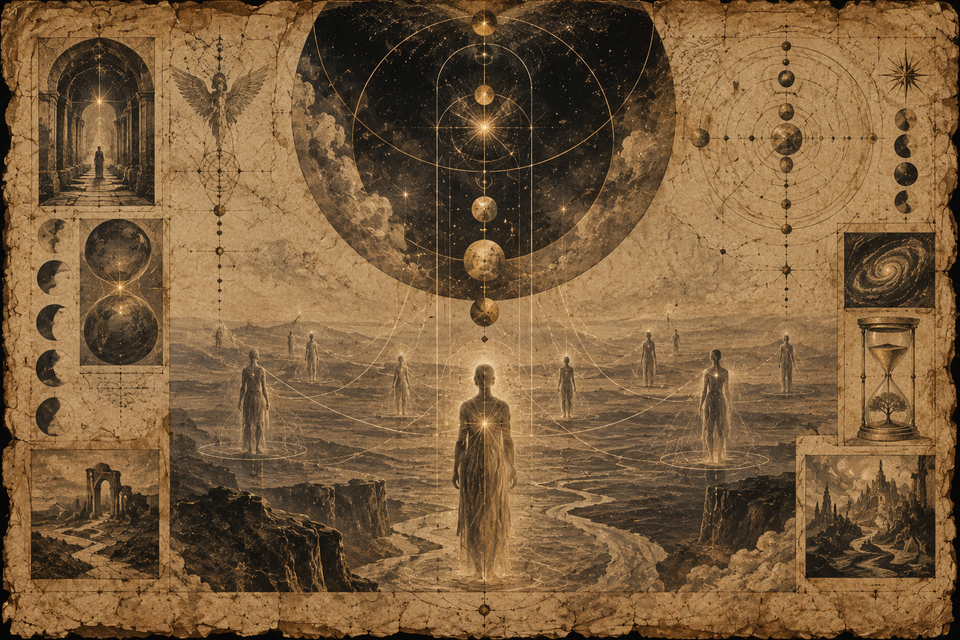
You can leave the relationship.
Move across the world, change careers, reinvent your personality, and heal the pattern you thought was responsible. Build an entirely different life around entirely different people... and somehow, years later, find yourself standing in front of the same fundamental lesson wearing a completely different face.
That is where the concept of a soul contract becomes interesting.
Not because every breakup was predestined, every difficult person was cosmically assigned to you, or every painful experience must therefore be endured. The more interesting question is structural: why do certain themes disappear when you change, while others survive enormous changes in circumstance?
Think about your own life. There are probably patterns you genuinely outgrew, the people who once attracted you no longer do. Situations that once activated your entire nervous system barely register. A fear that controlled your decisions for years loses its charge, and eventually you realize you have not encountered the same problem in a very long time.
That is what a completed pattern looks like.
But then there are the other ones. You leave the relationship in which you continually surrendered your authority, only to discover the same problem inside your career. You stop seeking validation romantically, then realize you are building your entire creative life around the approval of an audience. You leave the environment where you felt invisible, move somewhere completely different, and suddenly visibility becomes the central pressure point of your work.
The external variable disappeared.
The underlying developmental pressure did not.
At some point, “I keep attracting the same thing” becomes too shallow an explanation. What if you are not repeatedly attracting the same event? What if different events keep intersecting with the same coordinate?
That is the premise of the soul contract.
THE CONTRACT IS NOT THE PERSON
A soul contract is not a pre-written itinerary containing the exact people, jobs, relationships, betrayals, opportunities, and locations you will encounter during incarnation. It is better understood as a structural blueprint containing developmental coordinates: capacities the field is designed to build, thresholds it is designed to cross, and frequencies of experience capable of activating portions of the architecture that would otherwise remain dormant.
The Oversoul carries the larger architecture, while the physical personality represents a localized expression of it. Before consciousness is stepped down into physical density, specific resonant coordinates are encoded into the deeper scalar template. Those coordinates establish direction without necessarily prescribing route. Sovereignty may be one coordinate; embodiment, expression, discernment, self-generation, boundaries, leadership, or the ability to remain internally organized under pressure may be others.
This distinction leaves enormous room for free will. If sovereignty is one of the coordinates, there may be hundreds of physical routes capable of developing it. A controlling relationship can expose where authority is being surrendered; financial dependence can expose the same architecture. A career can reveal it through chronic deference to someone else’s judgment. Visibility can reveal it when criticism suddenly determines what you are willing to say.
Four different stories can therefore be carrying the same developmental vector.
The contract is not necessarily the person who activated it, the person may simply have been one physical point at which the deeper blueprint became impossible to ignore.
And that is where resonance becomes useful.
RESONANCE: WHY SOME EXPERIENCES HIT LIKE A TRUCK
In physics, a resonant system does not respond equally to every possible frequency. When an external driving frequency approaches one of the system’s natural modes, the amplitude of the response can increase dramatically. The external force does not create the resonant architecture from nothing; it interacts with properties the receiving system already possesses.
That gives us an elegant way to think about the strange inequality of human experience.
You can meet hundreds of people without any of them significantly altering your internal architecture. Then one person arrives and activates an almost absurd amount of material. You can hear the same idea ten times without caring, encounter it an eleventh time at a particular stage of your life, and suddenly reorganize your entire understanding around it. One opportunity looks objectively perfect and produces nothing internally, while another makes your entire system respond before you can logically explain why.
The magnitude of the response is not necessarily proof that the external thing itself is "destined," but rather evidence that it has struck something resonant inside the blueprint.
That difference matters enormously in relationships. Intensity can reveal significance without proving permanence. Someone can activate a core developmental coordinate without being the person who remains beside you after that coordinate has been integrated. A career can awaken a dormant capacity without becoming the career you keep forever, a particular environment can initiate a transformation without being where the transformed version of you ultimately belongs.
The external structure can leave.
The frequency it activated can remain.
And once that becomes clear, we can finally separate three mechanisms that are constantly collapsed into the language of destiny: the mirror, the catalyst, and the contract.
THE MIRROR, THE CATALYST, AND THE CONTRACT
A mirror reflects architecture that is already active within the localized field. If you carry an unintegrated abandonment pattern, chronic dependence on validation, an inability to enforce boundaries, or a persistent expectation of rejection, those structures influence what you notice, tolerate, pursue, reinforce, and remain attached to. Similar external dynamics can therefore continue stabilizing because the internal conditions supporting them have remained relatively unchanged.
The defining feature of a mirror is that when the internal architecture changes, the reflection can change with it. You stop negotiating your boundaries and suddenly the relationships that depended upon you having negotiable boundaries cannot stabilize. You stop interpreting inconsistency as desirability and a type of person who once consumed six months of your emotional bandwidth becomes unattractive in six minutes. The world did not necessarily become populated by different people; your field stopped providing the same access point.
A core contract behaves differently because the developmental coordinate exists beneath the particular distortion. You can resolve the romantic manifestation and discover the same deeper issue appearing through money, business, family, visibility, or creative expression. This is why the better question is not Who keeps appearing? but What keeps appearing when the people change?
Then there is the catalyst.
A catalyst is whatever introduces enough pressure to accelerate the developmental process. In chemistry, a catalyst facilitates a reaction without becoming the final product of that reaction. That distinction translates beautifully into the soul-contract model because something can be enormously important to your development without being designed to remain in your life forever.
A relationship may be contracted because it forces boundaries into existence, not because the relationship itself is permanent. An unstable period can develop self-generation without instability becoming your destiny. An environment can force you to locate your internal authority and become obsolete once that authority is no longer dependent upon the environment cooperating with you.
The catalyst is the pressure.
The contract is the capacity being developed through it.
This is why “Is this person part of my soul contract?” is usually the less interesting question. A much better one is:
What did this person activate that still exists when I remove them from the equation?
That is where the blueprint starts becoming visible.
Note: a contract is not infinite, it is simply an automated loop script. Once the capacity is fully built (e.g., you achieve absolute internal authority and phase-lock your heart-brain torus), the coordinate changes its spin-state. It shifts from Carbon-12 entropic absorption to Carbon-7 emissive broadcasting. The contract terminates because the hardware no longer possesses the frequency required to run the script.
FRICTION IS NOT THE DIAGNOSTIC
This also changes the way resistance has to be interpreted. If every difficult experience meant you were off path, then no developmental architecture could ever be tested under load; a boundary that has never encountered pressure remains theoretical. Self-trust that survives only when everyone agrees with you remains partially dependent upon consensus. Regulation that disappears the moment the environment becomes unpredictable is still relying on the environment to provide part of the regulation.
Pressure reveals what comfort can conceal.
For that reason, some incarnational vectors may deliberately intersect with dense or resistant environments because the capacity being developed requires something to develop against. A field functioning as a catalyst within a stagnant system may encounter resistance precisely because it introduces a pattern incompatible with the equilibrium already present there.
The existence of friction, therefore, tells us remarkably little on its own. The more revealing question is what the system becomes under that friction. Catalytic pressure should eventually produce increased capacity, stronger internal organization, clearer boundaries, or greater independence from the conditions that originally exposed the weakness. A repetitive loop behaves differently: it consumes enormous energy while producing very little new architecture.
A catalyst develops you. A mirror reveals you. A contract persists beneath changing circumstances.
An expired structure becomes increasingly unnecessary once its function has been completed.
And then there is another possibility entirely: you are applying enormous force to a life that is no longer moving in the same direction as the deeper vector underneath it.
This is where the physics gets considerably more interesting.
VECTOR DRIFT: HOW YOU CAN USE ENORMOUS ENERGY AND GO NOWHERE
A vector contains two fundamental properties: magnitude and direction. This matters because two large forces do not necessarily produce large displacement. If they are oriented against one another, their components can partially, or in an idealized case, completely, cancel.
Now apply that architecture to a human life.
Imagine the deeper blueprint producing a directional vector toward one developmental trajectory while the localized personality continually applies force toward another. At first, the angle between them may be small.
- You delay something you know needs to change.
- You remain in a container slightly beyond its useful life.
- You temporarily organize around someone else’s priorities.
There is still enough overlap between the vectors that life continues moving.
But as the angle widens, the energetic cost changes.
- The career requires twice the effort for half the return.
- The relationship needs constant intervention simply to remain at baseline.
- You repeatedly manufacture motivation for things that once produced it naturally.
- You change routines, environments, people, goals, strategies... anything capable of recreating the sense of momentum that used to exist.
You assume you need more energy. But within the vector model...
You have energy. It is being spent in opposing directions.
This is vector drift. The problem is not necessarily insufficient force; it is that the available force is no longer coherently aligned enough to produce equivalent displacement.
And that explains why stagnation can be so unbelievably exhausting.
SHEAR STRESS: WHEN TWO LAYERS OF THE SAME LIFE MOVE DIFFERENTLY
Structural mechanics gives us another useful principle; shear stress develops when forces act across a material in ways that tend to make adjacent layers slide relative to one another. The larger the incompatible loading becomes, the greater the internal deformation the material must accommodate.
The localized personality and the deeper blueprint are two layers of the same larger architecture attempting to organize physical reality along increasingly divergent trajectories.
Initially, the discrepancy may register only as subtle friction. Something feels slightly harder to maintain, a previously energizing environment feels heavy, the same work produces less internal return. A relationship requires more effort to preserve the same degree of connection.
As divergence increases, more of the system’s available energy is absorbed by maintaining the contradiction itself. The field is no longer simply moving through resistance; it is spending energy holding together a configuration whose components increasingly want to move in different directions.
That is why the experience can be confusing. From the outside, you may be doing more than ever. Internally, nothing seems to be accumulating.
Motion and displacement are not the same thing. Neither are activity and momentum.
THE LIMBO LOOP: WHEN LIFE DROPS INTO MAINTENANCE MODE
If vector drift persists, the field can enter what we have called scalar latency, or the limbo loop.
This is not necessarily the dramatic breakdown people imagine when they think of being “off path.” Quite often, nothing visibly catastrophic happens. You still work; you still maintain relationships, you still travel, exercise, make plans, answer messages, and do all of the things required to keep a life operational.
But the voltage changes. The future stops pulling.
Creativity has to be forced, opportunities appear but carry very little magnetism. Things you thought you wanted become strangely incapable of generating excitement. You can imagine several possible futures while feeling deeply connected to none of them. Days remain busy, yet months begin looking suspiciously identical from a distance.
This is what makes the limbo loop so expensive: there is enough current to maintain the life, but not enough directional coherence to expand it.
The response to persistent deviation is not immediate punishment or biological overload. Instead, active transmission can be damped. If increasing the voltage would simply increase strain against a localized structure that is refusing to translate it, reducing amplitude becomes protective. The deeper blueprint remains present, but the expansion current becomes less available to a system repeatedly demonstrating that it is not converting that current into coherent movement.
Essentially: the Oversoul temporarily rescinds voltage, connection, and gifts if the biological vessel refuses to listen to the signs being given.
This creates a distinction between rest and stagnation that is easy to miss. Rest reduces activity in order to restore capacity, while structural stagnation can persist even after rest because the issue is not simply depleted capacity... it is where the restored capacity is being directed. You can take the vacation, sleep for ten hours, change your routine, start a new project, and still encounter the same underlying flatness if the organizing vector itself remains unresolved.
Sometimes you do not need another sign. Sometimes the system has already delivered the information repeatedly.
What is missing is translation into matter.
WHEN THE GRAVITATIONAL PULL DISAPPEARS
As the core vector becomes increasingly damped, the person can experience another strange shift: the loss of internal magnetism.
A coherent trajectory tends to compound, and one decision makes the next one clearer. Ideas accumulate rather than constantly replacing one another. Relationships, opportunities, environments, and creative impulses begin clustering around a recognizable direction. Whether you describe this as resonance, synchronicity, attractor dynamics, or simple behavioral compounding, the subjective experience is similar: life has a direction of travel.
Vector drift weakens that organizing center.
Without a sufficiently strong internal beam, ambient currents begin exerting disproportionate influence. Someone else’s ambition becomes compelling. A new relationship becomes the center of the timeline, a new city promises the feeling of movement, or a new identity, opportunity, business model, spiritual practice, or social environment generates enough novelty to temporarily substitute for direction.
This is randomized timeline hopping.
The problem is not exploration, as exploration can be extremely coherent. The problem is that none of the trajectories receives enough sustained current to compound. Each possibility is energized until another one becomes louder, creating a life containing enormous amounts of change without an equivalent amount of construction.
The person may believe they need more options when what the system actually lacks is consolidation.
Possibility has become dispersion.
THE COMPRESSION LOOP: WHEN THE DETOUR GETS EXPENSIVE
A secondary trajectory can remain stable for a surprisingly long time even after it has stopped being energetically efficient.
Physics gives us a useful concept here: metastability.
A metastable system occupies a state that is locally stable even though another configuration may be energetically more favorable. The system does not automatically reorganize the moment a lower-energy state exists; it may remain trapped behind an activation barrier until sufficient perturbation pushes it beyond the threshold.
This is where the mechanics of vector drift and timeline collapse meet.
A life can be functionally stable and still be structurally expensive. The job continues paying, the relationship still technically exists, and the environment remains available. The identity still makes sense to everyone around you. Enough architecture is present to keep the existing state from collapsing, even though enormous energy is required to preserve it.
Eventually, however, the inefficiency begins appearing across multiple domains.
Work becomes increasingly difficult at the same time the relationship destabilizes. Financial structures shift. The environment becomes harder to tolerate. Opportunities that once allowed the trajectory to continue stop stabilizing; several seemingly unrelated areas begin applying pressure at once.
This is the compression loop.
From inside the experience, it can feel like reality is suddenly closing in.
Structurally, the existing configuration is approaching its transition threshold.
TIMELINE COLLAPSE AS A PHASE TRANSITION
This is where “timeline collapse” becomes much more interesting than the idea that the universe randomly decided to destroy your life.
Phase transitions occur when a system crosses conditions under which its previous organization can no longer remain the stable configuration. Near critical thresholds, relatively small changes can produce disproportionately large reorganizations because the system is already carrying the instability required for transition.
Water does not gradually become slightly more gaseous forever. Under the relevant conditions, the organization of the system changes state.
A secondary timeline can behave similarly. The relationship, career, environment, identity, social structure, and behavioral patterns supporting it may appear to be separate components, but together they form one larger configuration. Once the energetic cost of maintaining that configuration exceeds its ability to carry the deeper vector, the system approaches a critical point.
Then the external architecture can reorganize rapidly.
The relationship ends. The job disappears. The living situation changes.
The project loses viability, the social structure reorganizes.
What makes these periods feel surreal is their compression. Structures that seemed unrelated can change almost simultaneously because, at the level of the larger architecture, they were never completely unrelated. They were components stabilizing the same configuration.
Timeline collapse is therefore not the first moment something went wrong. It is the visible phase transition at the end of a much longer period of accumulating incompatibility.
The system simplifies through subtraction. And this explains something people frequently notice only afterward: clarity can arrive almost immediately once the collapse is complete.
The deeper signal may not have suddenly appeared.
The structures drowning it out finally disappeared.
WHY YOU CAN’T ALWAYS FORCE THE OLD TIMELINE BACK ONLINE
After a collapse, the first instinct is often restoration. Get the person back, rebuild the exact career, and recreate the old routine. Return to the old identity, solve whatever broke so the previous configuration can resume.
Sometimes that is appropriate. A disruption is not automatically a completed timeline.
But when the larger structure has actually crossed a phase threshold, attempts to restore the old configuration can require increasingly disproportionate energy because the system no longer possesses the same attractor dynamics that once stabilized it.
You can still force pieces back into place, they simply do not hold the same way.
This is why a person can technically reconstruct a former life and immediately realize that the thing they fought to recover no longer contains the frequency they remembered. The physical structure may be recognizable while the organizing current underneath it has changed.
The timeline did not collapse merely because something disappeared.
It collapsed because the old arrangement stopped functioning as a stable carrier for the next stage of the architecture.
DEVIATION IS NOT INVERSION
There is one final distinction that matters because these two processes should never be collapsed into the same category.
Moving away from the core blueprint is not the same thing as inverting it.
A person can spend years in vector drift. They can remain inside an expired relationship, build a career around someone else’s expectations, ignore repeated internal direction, lose momentum, become apathetic, enter the limbo loop, and experience an enormous timeline reset without fundamentally changing the polarity through which their field operates.
Deviation concerns direction.
Inversion concerns energetic orientation.
An organically connected field functions as a vertically linked, self-generating toroidal architecture. Higher-order current is stepped down through the Oversoul structure into a range the localized vessel can conduct, circulates through the field, and remains connected to the larger regenerative system. The individual exchanges energy with other people constantly, but the field does not fundamentally depend upon extracting another person’s current to preserve its own organization.
Inversion begins when that operating principle reverses.
THE PHYSICS OF AN INVERTED FIELD
As a localized consciousness deliberately organizes itself around predatory control, extraction, domination, manipulation, or the use of other fields as energetic supply, its polarity becomes progressively less compatible with the higher-order architecture feeding it.
That incompatibility produces progressive voltage decoupling. The Oversoul feed is stepped down rather than continually driven through a configuration operating at an opposing polarity. As inversion deepens, the direct vertical pathway becomes increasingly restricted, protecting the broader architecture from conducting the distortion upward through the same channel.
The consequence is a change in energetic economics.
An organic toroidal field is fundamentally self-generating within the larger Source circuit. An inverted field progressively loses access to that self-generating architecture while still requiring current to maintain its localized structure.
The resulting pressure differential creates dependence upon external supply.
Emotional manipulation, domination, fear generation, trauma loops, coercive dependency, obsessive entanglement, and predatory relational dynamics then function as mechanisms through which another field’s current becomes available. The more extraction replaces self-generation, the more necessary extraction becomes, creating a reinforcing circuit in which dependency secures access, emotional destabilization produces charge, and control maintains the connection through which supply continues.
This is fundamentally different from ordinary dysregulation. Human beings can become dependent, manipulative, trauma-bonded, controlling, or excessively reliant upon another person’s regulation without representing complete energetic inversion. The defining feature here is structural dependence upon extraction as the field’s operating model.
At the furthest edge of this architecture sits what we have described as monadic severance. If the localized configuration becomes completely incompatible with the original Oversoul matrix, continuity through the same scalar template can no longer be maintained. The distinction is between energy and organization: the underlying energetic substrate remains, while the configuration organizing it loses continuity.
The result is re-encryption. The inverted personality architecture dissolves back toward foundational Source units rather than reintegrating while preserving the same distorted organization. The energy remains available to the larger field; the inverted configuration itself does not.
In human language: when an organic, self-generating soul stream intentionally and repeatedly chooses malice, harm, or fear, it cannot stay generating Source current as it is no longer in resonance with that flow. Instead, it cuts off and needs to feed on other's currents, resulting in siphoning and energy harvesting. When the incarnation completes, as the individualized node has lost their Source current, they are simply reabsorbed back into the field as data. The individual personality is not retained, as there is no 5D connection left. The Oversoul does not die, just the fractal of consciousness.
Inversion, therefore, is not an extreme version of being lost.
It is a fundamentally different energetic architecture.
THE BLUEPRINT YOU CAN’T OUTRUN
When all of these mechanics are placed together, the soul contract stops looking like a cosmic list of events you were obligated to experience before you were born. The process becomes something much more interesting:
- The blueprint establishes developmental coordinates.
- Resonance explains why particular experiences activate those coordinates with disproportionate force.
- Mirrors expose localized architecture that can change.
- Catalysts place enough pressure on weak points to force adaptation.
- Contracts persist beneath changing circumstances because the developmental vector is larger than any single person or event through which it appears.
- Vector drift begins when the localized life increasingly organizes around directions that fail to compound with that deeper architecture.
- Opposing vectors consume energy without producing equivalent displacement.
- Prolonged divergence creates shear, damping, and eventually the limbo state in which the life remains operational while its sense of expansion disappears.
- Without a strong internal vector, secondary timelines become increasingly magnetic, dispersing current across possibilities that generate movement without construction.
- Eventually, the energetic cost of maintaining the detour can exceed the stability it provides.
- Compression increases.
- The metastable configuration approaches its threshold.
- And when the existing architecture can no longer efficiently carry the deeper vector, timeline collapse functions as a phase transition: the structures stabilizing the old configuration reorganize, sometimes with enough speed that an entire chapter appears to disappear at once.
Seen this way, the deepest question is no longer whether every person you meet was written into your soul contract.
It is whether you can identify the coordinate underneath the people.
Who leaves while the lesson remains?
Which patterns disappear once you change, and which ones simply migrate into another area of your life?
What pressure keeps developing the same capacity?
Where are you genuinely being challenged, and where are you spending enormous energy forcing a structure that no longer produces displacement?
What keeps returning after the relationship, career, city, identity, and timeline surrounding it have all changed?
That is where the blueprint becomes visible. A prison eliminates choice; a blueprint does not. You can approach the coordinate directly, circle it for years, explore secondary trajectories, resist the pressure that exposes it, or build elaborate physical structures around avoiding it. Free will determines an enormous amount about the route.
But changing the route does not necessarily change the underlying developmental coordinate.
And perhaps that is why some lessons seem impossible to outrun.
You were never being chased by the same person, circumstance, or timeline.
You were encountering the same architecture through different matter.
None of this implies that the theater of your life is populated by random extras. While the contract is fundamentally about the capacity being developed, specific individuals absolutely sign on to play hyper-targeted roles in your timeline. Think of it as a form of cosmic casting: certain souls agree to step into your field at precise chronological coordinates to play the antagonist, the betrayer, or the catalyst. They carry the exact energetic chemistry required to make the pressure real enough to force a system reboot. Intensity reveals significance without proving permanence; sometimes the people who loved your soul the most before incarnation are the ones who agreed to play the heaviest, most destructive roles in your physical story just to ensure your hardware finally woke up.
Ready to step into The Inner Stream?
If this public transmission resonated with you, there is a much deeper current waiting. Subscribing unlocks two exclusive, high-voltage newsletters every single week, plus instant access to our complete archive of over 60+ past transmissions. Plug into the sovereign field for just $33/month.
Member discussion