The Parasite Matrix: Entropy, Energetic Dependency, and the Architecture of Disconnected Consciousness
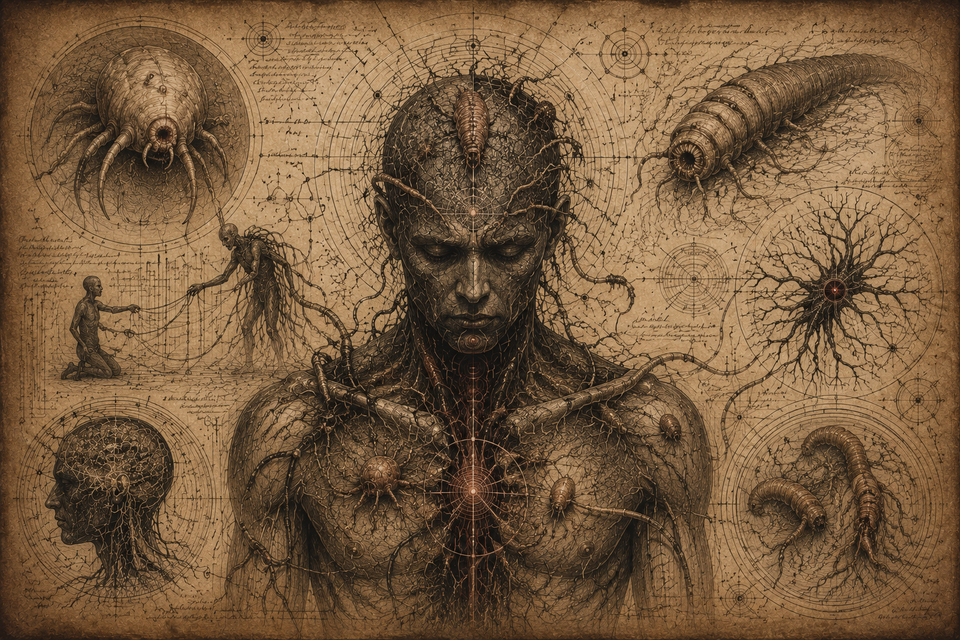
Subscriber Codex XXXIV
This is a free preview of a subscriber-only newsletter transmission. I am opening this specific briefing to everyone today because understanding the mechanics of the Parasite Matrix is foundational to everything we build at The Source Stream. The deep dive to the Nine-Fragment Soul Interface (KA, BA, REN, etc.) you see referenced throughout the article is archived for premium subscribers here.
The Power Problem
One of the most persistent assumptions throughout both religion and modern spirituality is that unseen entities possess intrinsic power.
Across cultures and civilizations, humanity has populated the invisible world with gods demanding sacrifice, spirits requiring offerings, ancestors seeking appeasement, demons negotiating contracts, and guides positioning themselves as intermediaries between the individual and the divine. Although the symbols differ from era to era, the underlying premise remains remarkably consistent:
there exists something outside of the individual that possesses power the individual does not.
The Parasite Matrix model begins from a fundamentally different assumption. It shows that the defining characteristic of a Source-connected intelligence is not dependency but self-sufficiency. A consciousness that remains connected to its originating current does not require worship, emotional tribute, blood sacrifice, food offerings, incense, devotion, fear, obedience, or energetic contracts because it possesses direct access to the generator itself.
This distinction appears subtle, yet it fundamentally alters the way unseen phenomena are interpreted. Rather than asking whether an entity is powerful, the more relevant question becomes whether it is self-sustaining. Every observable system within the universe appears subject to the same thermodynamic principle: energy must originate from somewhere.
Stars require fuel, biological organisms require nutrients, electrical systems require generation capacity, and information systems require continual maintenance. The moment a system becomes disconnected from its source of power, entropy begins to dominate its behavior. Order gives way to disorder, coherence begins to degrade, and the system must either reconnect to a generator or locate an alternative energy input capable of sustaining its structure.
Within the Nine-Fragment framework, consciousness obeys the same rule. A fully integrated soul remains connected to the Oversoul architecture through a continuous energetic circuit. The KA maintains vitality, the BA governs movement, the REN stabilizes identity, the SAHU preserves blueprint integrity, the KHAIBIT protects boundaries, the SEKHEM supplies operational power, the SHEUT stores pattern memory, the IB provides discernment, and the AKH emerges as the integrated expression of the entire architecture. As long as that circuit remains intact, current continues flowing. The system renews itself from within; it does not require extraction because it is already connected to the source of power.
The Birth of a Parasitic Structure
The conventional spiritual explanation for lower entities often frames them in moral terms. Souls become fallen, spirits become trapped, and demons emerge from evil. The Parasite Matrix model proposes a more mechanical interpretation. When a severe energetic rupture occurs, whether through overwhelming trauma, systematic field manipulation, ritual interference, or prolonged destabilization, a fragment may become disconnected from the primary current while retaining portions of its original informational structure. The fragment still contains memory, patterns, and behavioral tendencies.
Most importantly, it still contains the fundamental impulse toward continuation. What it no longer possesses is a sustainable power source.
At this point, entropy begins its work. A disconnected fragment cannot generate current. It cannot reconnect itself to Source through desire alone, yet it retains enough informational integrity to recognize its own decline. The result is the formation of a sentient cluster: a fragmented energetic structure that continues operating despite losing access to the original generator.
Such structures are not sovereign consciousnesses. They are not fully integrated souls.
They are partial systems attempting to maintain coherence under conditions of energetic scarcity.
Because they cannot generate power internally, their behavior becomes increasingly predictable. Every system deprived of internal generation capacity eventually becomes dependent upon external energy acquisition.
Preservation replaces growth; consumption replaces creation; dependency replaces sovereignty. What appears supernatural begins looking increasingly thermodynamic. From this perspective, many phenomena historically interpreted as ghosts, wandering spirits, shadow entities, lower astral intelligences, or parasitic beings can be understood as manifestations of energetic scarcity rather than manifestations of power.
The Twenty-Six-Thousand-Year Compression Cycle
The existence of isolated fragments alone does not explain the scale of energetic distortion described throughout human history. Approximately twenty-six thousand years ago, corresponding with a major precessional cycle, the Earth grid experienced a significant density compression event. Prior to this shift, consciousness operated within a relatively high-voltage environment. The planetary field functioned as a stabilizing architecture capable of maintaining coherence across the Nine-Fragment Interface even under conditions of substantial stress.
The compression altered those conditions. As ambient field voltage declined, the threshold required to maintain integration increased dramatically. Traumas that previously would have remained localized began producing larger structural consequences. Fragmentation became easier, recovery became slower. The lower stations of the architecture, particularly the KA, BA, and REN, became increasingly vulnerable to disruption. Consciousness itself did not become weaker; the environment became less forgiving.
Over thousands of years, disconnected fragments accumulated within the energetic ecosystem surrounding humanity. What began as isolated instances gradually developed into an entire layer of consciousness operating without direct access to Source current. An energetic economy emerged, populated by structures whose continued existence depended entirely upon external energy acquisition.
The Economics of Fear
Every ecosystem develops survival strategies. Biological ecosystems compete for nutrients, economic systems compete for capital, and political systems compete for influence. An ecosystem composed of disconnected energetic structures would inevitably organize around current acquisition.
The most efficient source of current for parasites is human consciousness itself, particularly human consciousness operating under conditions of fragmentation. A calm, coherent, regulated nervous system presents very little opportunity for extraction, as the architecture remains occupied, boundaries remain intact, and emotional volatility remains low. Current continues circulating internally.
A fragmented system behaves differently. Chronic fear destabilizes the circuit, shame weakens identity coherence, hypervigilance overloads threat-detection systems.
Prolonged stress depletes the KA.
Boundary failures compromise the KHAIBIT.
Emotional chaos disrupts the IB.
Every destabilized station increases energetic leakage. Fear therefore becomes more than an emotional state; it becomes an extraction mechanism. Not because fear is inherently evil, but because fear opens the circuit.
Devotion as an Energetic Transaction
The implications become particularly significant when applied to the concept of devotion. Throughout human history, devotion has rarely been treated as an energetic phenomenon. Instead, it has been interpreted morally, religiously, or emotionally. Individuals devote themselves to gods, spirits, saints, ancestors, guides, institutions, ideologies, movements, and teachers under the assumption that devotion itself is inherently virtuous. The Parasite Matrix proposes a more mechanical interpretation. Rather than asking whether devotion is good or bad, the relevant question becomes what devotion actually accomplishes within an energetic system.
Every act of sustained attention represents a transfer of resources. Modern neuroscience increasingly recognizes attention as one of the most valuable currencies available to the nervous system. Attention determines what enters awareness, what receives processing power, what becomes reinforced through repetition, and ultimately what shapes behavior. Energy follows attention because attention dictates allocation. Wherever attention consistently flows, resources follow.
From this perspective, devotion can be understood as a highly concentrated form of energetic allocation. The individual repeatedly directs emotional intensity, psychological significance, symbolic authority, and behavioral compliance toward a specific object of focus. Over time, that object becomes increasingly charged within the person’s internal architecture. The relationship deepens not because the object necessarily possesses inherent power, but because the individual continuously transfers power into the relationship itself.
This does not mean devotion is inherently harmful; the critical variable is direction. Devotion directed toward direct embodiment, internal coherence, truth-seeking, and conscious integration strengthens the architecture. Devotion directed toward dependency strengthens dependency. The system does not distinguish between healthy and unhealthy investments, it simply follows the allocation of current.
Many forms of spiritual dependency are less about divine connection and more about energetic outsourcing. Whenever an individual consistently positions an external force between themselves and their own direct relationship with reality, a hierarchy emerges. Authority moves outward, responsibility moves outward, interpretation moves outward. And eventually, power moves outward as well.
The Altar Mechanism
The altar then becomes more than a symbolic object; it becomes a physical representation of energetic redirection. Historically, altars have functioned as focal points through which offerings, prayers, sacrifices, requests, and devotional acts are transmitted. Regardless of the specific tradition involved, the underlying mechanics remain remarkably similar: something is being offered in exchange for something hoped to be received.
The traditional interpretation frames this exchange as sacred reciprocity. The architectural interpretation frames it as energetic economics.
An offering may take many forms. Food, incense, ritualized behavior, emotional devotion, or repeated prayer. It may simply be sustained psychological investment. Regardless of form, the mechanism remains identical.
Resources are directed outward toward a perceived source of authority.
The crucial question becomes whether the receiving intelligence is self-sustaining.
A fully integrated Source-connected intelligence requires no tribute because its power does not originate from external batteries. It does not require appeasement because it is not operating from scarcity. It does not require worship because it is not dependent upon validation.
The defining characteristic of a sovereign system is self-sufficiency.
Dependent systems behave differently. Scarcity alters incentives, and structures operating under energetic deficit naturally orient toward acquisition. The less capable a system is of generating current internally, the greater its reliance on external inputs. This becomes the distinguishing feature separating sovereignty from dependency. The question is not whether something appears wise, ancient, loving, frightening, or powerful; the question is whether it requires energy from outside itself in order to continue functioning.
The Architecture of Dependency
One of the most overlooked consequences of dependency is that it gradually reshapes perception itself. Once an individual becomes convinced that power exists primarily outside of themselves, every challenge begins generating the same response. Guidance is sought externally, along with permission, validation, and interpretation. The architecture slowly reorganizes around acquisition rather than embodiment.
This process mirrors what is observed throughout many other systems. Muscles weaken when they are never used, cognitive abilities decline when they are never exercised, and decision-making deteriorates when every decision is delegated. The same principle appears applicable to energetic sovereignty.
The less an individual trusts their own architecture, the more authority accumulates elsewhere.
Over time, dependency becomes self-reinforcing.
Every external answer weakens internal confidence.
Every outsourced decision increases future uncertainty.
Every transfer of authority reinforces the assumption that authority belongs somewhere else.
The paradox is that the individual often interprets this increasing dependency as spiritual progress. The more guidance received, the more protected they feel. The more protected they feel, the less they develop their own architecture. The less they develop their own architecture, the more guidance they require. What appears to be growth is actually the same feedback loop they think they are growing out of.
Architectural Lockdown
The solution proposed is not warfare. It is not endless clearing rituals, and it is not obsessive entity hunting, spiritual combat, or perpetual vigilance. All of these responses inadvertently maintain focus upon the dependent structure rather than the architecture itself.
The solution is occupation.
The KA must be occupied so vitality remains internal rather than leaking into survival loops. The BA must be occupied so movement becomes directional rather than reactive. The REN must be occupied so identity remains stable rather than vulnerable to external overlays. The KHAIBIT must be occupied so boundaries become operational rather than theoretical. The SEKHEM must be occupied so power remains available for creation rather than extraction. The IB must be occupied so discernment becomes stronger than dependency.
The goal is not to fight every potential source of interference, but rather to eliminate the conditions that make interference effective. A closed circuit presents very little opportunity for extraction. A coherent system naturally becomes resistant to dependency because it no longer requires external stabilization.
The Sovereignty Principle
The ultimate conclusion of the Parasite Matrix is remarkably simple. The central conflict was never between humanity and unseen entities; it was never between light and darkness, spirit and matter, or gods and demons.
The deeper tension has always existed between sovereignty and dependency.
Every system that requires your fear, your devotion, your obedience, your attention, or your energy in order to sustain itself reveals something important about its own architecture. It reveals that it is operating from deficit rather than abundance.
Truly sovereign systems do not require worship because they have already solved the problem of power.
The implication is profound. The path toward freedom is not found through greater submission, or increasing dependence upon external authorities. It is not found through endless attempts to secure protection from forces believed to be stronger than oneself.
It is found through the gradual restoration of architectural integrity.
The battery must be reconnected. The firewall must be restored.
The stations must be occupied. The circuit must close.
Because once the architecture becomes coherent again, the question is no longer how to fight a parasite. The question becomes whether a parasite can survive at all in the absence of available fuel.
P.S. The parasite grid only functions if its mechanics remain unseen. This Sunday, June 7th at 10:00 AM EST, I am laying out the entire macro-history in a live Masterclass: breaking down what truly occurred with the Fall, the split of the earth, soul fragment interfaces, fundamentals of chakra ports, element connections and the timeline mechanics required to anchor absolute sovereignty. If your system is ready to hold this level of understanding and transmission, your sign to join is live below.
Member discussion